

When you go to buy cameras, you will soon come across the terms “full frame” and “crop sensor.” So, for the casual photographer, the vlogger, and the next generation of camera consumers, here is what you need to know about crop sensor cameras so that when it comes time to buy your camera, you will do so smarter and more in line with how you shoot and your budget and/or lens plans.
This tutorial will clear up the mysteries of crop sensor cameras, what crop sensors do to the size, image quality, and price, and how crop sensor cameras differ from a full-frame body (full frame vs crop sensor camera). I will also suggest some of my best crop sensor camera choices in Canon, Nikon, and Sony, and an overall Mirrorless choice you can affiliate with.
What is a crop sensor camera?
A crop sensor camera has an image sensor that is smaller than the 35mm “full-frame” sensor. This is possible because the lens in the smaller sensor projects an image circle that is banded in effect, meaning that the field of view is narrowed relative to that of an equivalent lens on a full-frame camera. The difference is described as the crop factor multiplier, which you would multiply the focal length of a lens by to obtain the “35mm equivalent” field of view. As an example, APS-C (Advanced Photo System-Classic) bodies made by Canon apply the 1.6x crop factor, but those made by Nikon and Sony generally apply 1.5x.
So why is this practically important: a 50mm lens on a Canon body with an APS-C sensor provides the equivalent field of view of an 80mm lens on full-frame (50 divisible by 1.6 = 80). Therefore, a lens that offers a similar focal length can be used as a longer one, but without having to take on the purchase of a longer lens. This makes crop-sensor rigs appealing to the budget-conscious wildlife and sport industries.
Crop factors and sensor sizes (at a glance)
- Full-frame (35mm): 36 x 24 mm, the standard reference size in focal length equivalence.
- standard: APS-C: about 23.5 x 15.6 mm (Nikon/Sony) or ~22.3 x 14.9 mm (Canon). The latter differences result in the universal 1.5x (Nikon/Sony) and 1.6x (Canon) multipliers.
calculation:
The focal length in 35mm equivalent = the focal length of the lens multiplied by the crop factor.
Example: a 35mm lens on a Nikon APS-C (~1.5x) = ~52.5mm equivalent.
Size and portability, lenses, and ergonomics
The fact that such a camera has smaller bodies and lighter lenses is one of the most practical advantages of a crop sensor camera.
- Physically smaller and lightweight: Smaller size and weight of APS-C camera bodies are possible over full-frame equivalents, as the sensor is smaller, as well as some of the electronics. This is a win on travel, vlogging, and long handheld shots.
- Fewer and lighter lenses: APS-C lenses can be made with less glass and with less weight; that reduces the overall weight of the kit.
- Comfort and concealability: Smaller arrangements look less threatening in the street to shoot and are less cumbersome to carry around.
Portable on-the-pick choices: small APS-C mirrorless bodies are popular with creators and would include the Sony ZV-E10 (vlogs) or Canon eR10, which focus more on lightweight flip screens and convenient handling. (Product choice below.)
Quality-image performance, low light, depth of field
The sensor size does have a direct impact on a couple of the image properties:
- Low-light capabilities/noise: The larger sensors gather extra light per pixel; the measurement is equivalent at aperture and ISO, so the full-frame cameras tend to offer cleaner outputs at high ISO. However, recent APS-C sensors are lightyears better: most daily content and Web publishing can be well accommodated with crop sensors.
- Dynamic range: Full-frame sensors are slightly superior in terms of dynamic range, which allows recovering highlights and shadows. Such an edge is the most essential in the view of photo work (landscape, studio).
- Depth of field: APS-C bodies, at the same framing at the same aperture, offer a deeper depth of field than full-frame, and thus it can be a bit more difficult to achieve extremely shallow background blur using the same lenses. You may compensate with faster (wider) lenses or additional focal length.
- Resolution & detail: Most crop-sensor camera bodies are now loaded with high-resolution sensors (20-33 MP+), so they provide excellent detail at up to moderate print sizes, on the web, and social media.
In summary, crop sensors sacrifice a bit of extreme low-light/dynamic range capability in favor of portability and cost; in most cases, however, APS-C cameras these days deliver more than enough.
Price points: APS-C costs less to own
One big factor when customers select to use crop sensor cameras is cost:
- Low body price: APS-C cameras tend to be cheaper than the full-frame models, which are of similar characteristics. That is why they are suitable for beginners and those who care about the budget.
- Affordable lens: Since lens designs can be simpler and cheaper to produce when specifically designed to fit APS-C (a smaller image circle means simpler mechanics to encompass that image), the price of lenses can be reduced.
- Fast upgradeability: They are far more affordable to fill out as a good kit (body + flexible zoom + prime) than a full-frame one.
Later, upgrade to full-frame bodies (at least with some minimum systems (Canon RF-S, Sony E, Nikon DX Z)) so that you can use some of your original lenses or adapters based on your lens plan.
Notes on compatibility & ecosystem (lens)
- Native APS-C lenses: All important models have APS-C glass (e.g., Canon RF-S, Nikon DX, Sony E APS-C). These are cost-effective and size-optimised.
- Full-frame lenses on APS-C: Functionally, this is no problem at all, though the lens will be bulkier than before and perhaps heavier.
- Adapters: With many mirrorless systems, it is possible to use legacy lenses using adapters. It could be a cost-effective method of getting some interesting glass.
Full Frame vs Crop Sensor Camera – short comparison
- Portability & cost: Crop sensor—better.
- Bad light/shallow DOF: Full frame – superior.
- Telephoto work (no tele operating): Crop sonority -better (additional apparent focal range).
- Lens price & system price of entry: Crop sensor—typically lower.
APS-C is regularly the most sensible, usable option if you work with web/video, travel frequently, or are tight on budget.
Best Crop sensor cameras(Top Picks)
Canon – Top crop sensor Canon camera: Canon EOS R7
Good all-rounder that targets enthusiasts looking to go fast and deliver some good picture quality in APS-C. With its 32.5MP APS-C sensor, high-speed continuous shooting, robust autofocus, and good video functionality, the EOS R7 is perfectly placed for action, wildlife, and hybrid shooters alike.
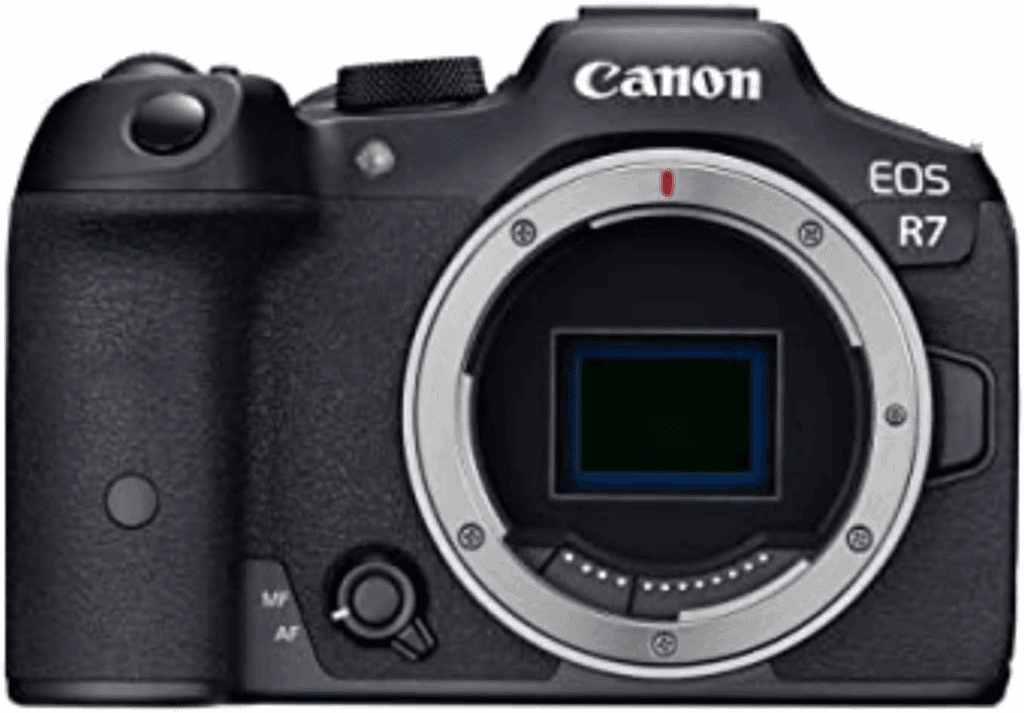
The reasons that it is recommendable: Good resolution, Autofocus performance, and the native RF-S lens system.
Affiliate Link: Canon EOS R7
Better overall mirrorless crop sensor camera—Fujifilm X-S20
The Fujifilm X-Series’ combination of excellent color science, film simulations, and 26.1MP X- Trans APS-C sensor, plus easy-to-use controls and stabilization options, make it a fantastic hybrid camera that suits artists equally interested in taking great photos and taking great video.

Why it is recommended: It is a really well-colored one, with a small physical body and dual-oriented capabilities that are appealing to not just the photographers but the vloggers as well.
Affiliate Link: Fujifilm X-S20 Mirrorless Digital Camera XF16-50mmF2.8-4.8 R LM WR – Black
Nikon—Best Nikon crop sensor camera: Nikon Z50 / Z50 II
The cheaper, smaller Nikon Z50 series (20.9MP APS-C) is also lightweight, enjoys clean imaging and good AF, and fits into the Nikon Z-mount ecosystem. The newer Z50 II refresh is minor, with processing and usability enhancements. Travel and street shooters are great.

Why it is recommended: well-balanced still/video with a compact body and established image quality.
Affiliate Link: Nikon+Z50+/+Z50+II
Sony—Top Sony crop sensor camera: Sony a6700
Sony’s a6700 packs superior autofocus and meaty video chops into the APS-C sphere, with a 26MP sensor and modern video functions (4K up to high frame rates), meaning it’s a great fit for hybrid creators and vloggers who want punch-for-money in a pocketable package.

Why it’s recommended: Great AF, video capabilities, and a ton of E-mount lenses.
Budget/Vlogger choice—Canon EOS R10
For those just beginning, the Canon EOS R10 is a great value: 24.2MP APS-C sensor, fast burst shooting, and entry-level ergonomics—a sensible entry point into the RF mount.

Why it’s recommended: Top value, compact design, and features catered to content consumers.
Affiliate Links: Canon+EOS+R10
Practical buying suggestions
Choose what is more important to you: travel/weight, low-light, or video capabilities. Adjust that priority to your budget.
- Body: The lens roadmap is what counts; select at least one high-quality prime or flexible zoom. Turning basics Lenses last longer than bodies.
- Check stabilization: IBIS is a huge benefit on handheld videos and low-light still stuff—very useful on small bodies.
- Demo it, and you will know: ergonomics and menu systems vary– handle the camera in the shop, where possible.
- Sell smart: bundle the above kit with a fast prime lens (e.g., 50mm f/1.4 or 50 f/1.8) as an upgrade for portraits and low-light work and watch the average order value jump.
FAQ
Q – Should I get a crop sensor camera to use on YouTube and social media?
A-Of course. Modern crop sensors provide great image quality; combine that with a decent lens, and you have social, vlog, and documentary coverage.
Q – Will I lose professional quality with APS-C?
A – Not necessarily. APS-C bodies are utilized by many pros as backup systems (lightweight) or in a few assignments (wildlife, travel). Full-frame is more important in some studio pieces and large prints.
Conclusion
The crop sensor camera has superb real-world value: portability, additional reach thanks to the crop factor, and reduced system cost but with no compromise to the image quality that most photographers and creators require on the web, social media, and most print work. A smart but affordable cheat to a pro-level presentation, in the eyes of the amateur and most content creators, include an APS-C mirrorless camera (Canon, Nikon, or Sony, or Fujifilm).